I pour my heart, my soul, everything that I have learned and developed from into a simple three page narrative.
And then I watch it turn into four measly numbers.
Four measly numbers which state how this should be changed, how that does not sound "good", and "use a different phrase here".
None of these other papers really matter. These are simple research, essay, papers which do not require any emotion, really. They are just simple facts and opinions on a page. Make those all up, I do not care about them.
But do not say that my life story is shit.
I've been writing that story in my head for three months, picturing myself talking to my friends about my past and how it has affected my future. And all I receive back is a "good word choice."
Tuesday, November 19, 2013

Friday, November 8, 2013
Monday, November 4, 2013
Children
Today I helped out at Oxbow Elementary to get service hours for NHS.
After doing research for the ethnography, I discovered that I am now observing different groups of people that I encounter.
I watch as the teacher interacts with other teachers, trying to figure out how a new app works on their tablets. I also watch the kids interact with the teacher, and how the react to me being in the room now. It actually is really interesting when you don't have to write a paper about it.
I introduced myself to the kids today, and they asked questions like "What's your favorite color?" "How many brothers and sisters do you have?" "Do you have a boyfriend?" "Do you make out with your boyfriend?"
I didn't answer the last question. Obviously.
I also learned that classes now are integrating special needs students more into the classroom, instead of having them in a special class. I think that's a great idea, because they get the interaction with other students that they need, but I need to ask the teacher if they get any special work or go to a tutor for part of the class to receive extra help. They need to be treated like children, instead of special help cases, though.
Wednesday, October 30, 2013
Group Theory Part 2 - Inner Works of a Group
Part two of my theory. This time, the inner workings of a group.
Now I'm not quite sure if this is all correct, this is only one day of thought and contemplation, so please feel free to pitch in if you have any suggestions.
Now these single groups are not perfect circles, they are more like blobs which overlap and mold with other friend groups. I'll explain more on that in a later post.

Also, sorry for the picture quality, my scanner isn't working.
These groups consist really of layers, or different sections. Some larger groups will have more sections, and some groups will have less. The main leaders of the group are in the very center, and since it's smaller, it consists of less people, and is also very hard to get in. As you work towards the outside, there you will fine more and more people who are less associated with that specific group, where finally you reach the outliers. Outliers will have mainly one or two friends that are somewhat associated with that group, but other than that, they are not really involved. This is also the edge where one group ends and another will begin.
Sometimes, when a larger group is present, a "crescent" effect will appear. This effect is more associated with the outer core/inner edge people. This is when one section of the friend group has a tendency to hang out with 3 or 4 main people of that section, but if a large event occurs, they will all hang out together. For example, say a random person named Keri has two main friends that she hangs out with in this friend group, and Sarah (also in the friend group and in the same section) hangs out with two other friends. These two "crescents" are on opposite sides of the circle. Yet when a gathering is held (say at Valleyscare), all six of these friends will hang out together.
Is any of this making sense?
(Stay tuned for Part 3: Group Connections)
Monday, October 28, 2013
Group Theory Part 1 - Basics of a Single Group
I have a theory.
This theory is going to take awhile to explain, so I am going to spread it across a couple of blog posts.
So of course in high school we have friend groups, right? These friends we hang out with all the time, etc. And we don't only have one friend group, we are usually associated with multiple friend groups. So what if there is a science, some sort of theory, that shows how we interact with outside friend groups, and how we communicate with others?
 Let's start with one friend group. As far as I see it, one "group" consists really of a bunch of rings, depending on how "involved" you are in that group. The people who are in the innermost ring, or "inner core" as I like to call it, are the main people of this group; they really are the reasons why this group exists. Everyone in this group knows these people, and perhaps (I'm not quite sure) they are the ringleaders.
Depending on their importance, other friends within this group would be scattered about the rings. If one is less involved in the group, then they would lie on the more outer edge of the rings, and so on. The inner working of a single group is more complex and harder to understand, so stay tuned for my next post on how that works out, and then later, how all the groups fit together.
This theory is going to take awhile to explain, so I am going to spread it across a couple of blog posts.
So of course in high school we have friend groups, right? These friends we hang out with all the time, etc. And we don't only have one friend group, we are usually associated with multiple friend groups. So what if there is a science, some sort of theory, that shows how we interact with outside friend groups, and how we communicate with others?
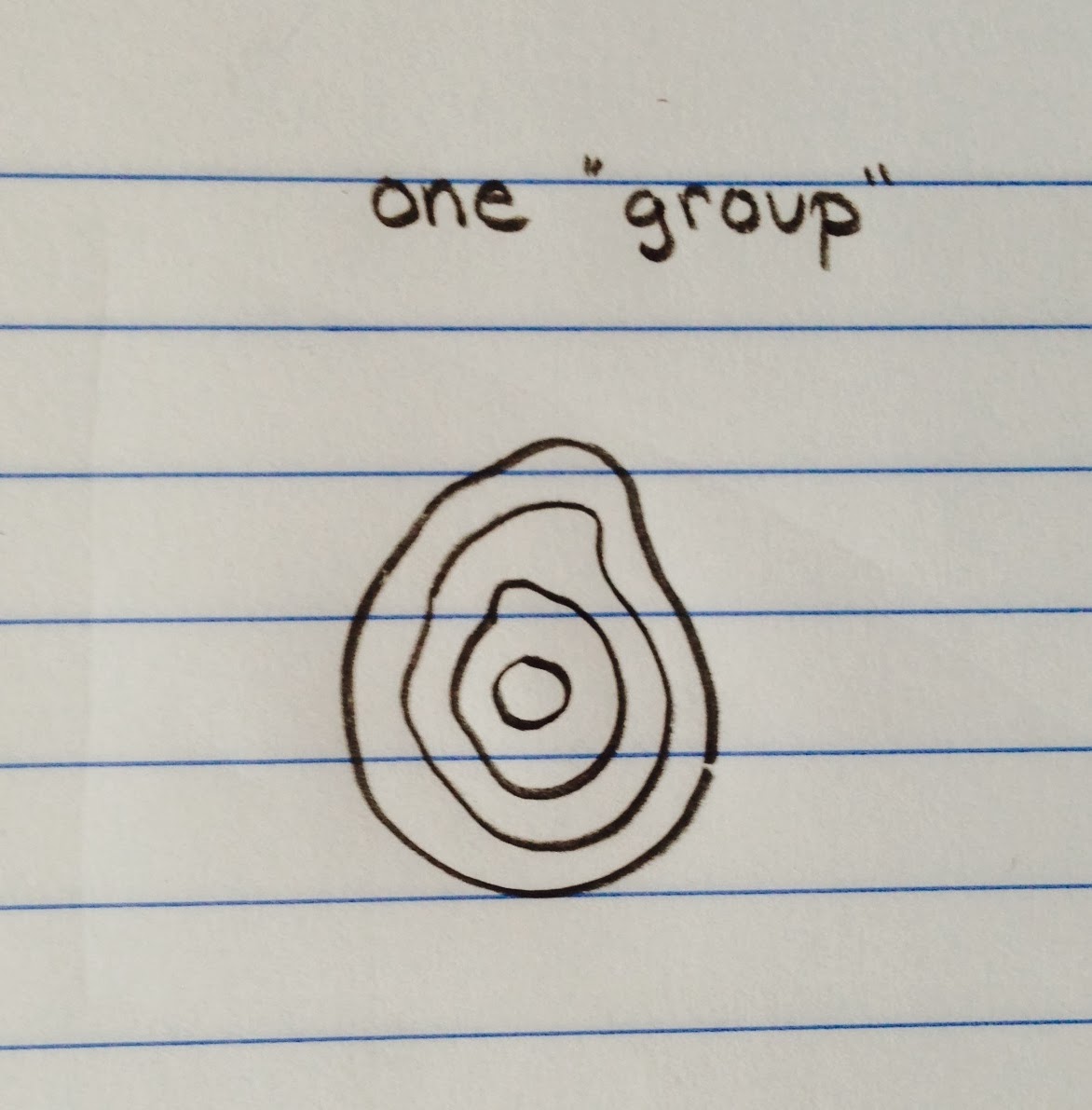
Depending on their importance, other friends within this group would be scattered about the rings. If one is less involved in the group, then they would lie on the more outer edge of the rings, and so on. The inner working of a single group is more complex and harder to understand, so stay tuned for my next post on how that works out, and then later, how all the groups fit together.
Friday, October 25, 2013
Q + A
It's funny the different interviewing answers you receive from people merely by age.
When I interviewed the workers at New Horizon for my paper, I started with one lady who worked in the infant room. She was around 40-50 years old. When she answered my questions, she answered in full detail, giving emotions, examples, everything about why she chose to work there and everything.
Yet when I interviewed a 20 year old working there, her answers were very short, brief, and to the point.
I don't know if this is because of the age difference, or perhaps the generation, but it would be something really interesting to research. I can see how maybe younger people are trying to get stuff done faster so they can move on to the next project, and older folk tend to slow down, and give great details.
Or maybe it's the fact that the older workers there are working there simply because they love the job, while younger adults are there simply for the job and money
Either way, it's really interesting to see the difference.
Monday, October 21, 2013
Procrastinate
I was planning on going to the daycare today in order to get 2 of my last four hours in for my ethnography.
Except that I didn't.
At this point in the ethnography, I don't know what to write in my notebook for observations. I just have to write whatever the adults are talking about. The first couple days I am able to write descriptions of the people, the rooms, the objects they use, but after I got all of the descriptions down, I was sitting, waiting for something to happen.
Is this the part of the project where you slowly start to immerse yourself into the culture itself? Interacting with the group, becoming one of them, etc?
Honestly at this moment I am far too tired to really be thinking deep about anything.
Subscribe to:
Posts (Atom)